Give or Take
Three kilometers down there is rock no human will ever touch. And in my thesis, I told everyone exactly how empty it is.
That's what porosity is. The hollow fraction of a stone. The little pockets where oil and gas and water sit, waiting. Read it right and you've found the reservoir. Read it wrong and someone burns a few million dollars drilling into solid rock that promised to be generous and wasn't.
So. How do you measure the empty space inside something you can never reach?
The honest answer is you don't. You drill a well, you pull a core, you run a tool down the hole, and now you know the porosity of one pencil-thin column, at one spot, after spending a fortune to stand there. The other eighty thousand square kilometers of the Malay Basin stay dark. Fourteen kilometers of sediment, and you've lit a single candle in it.
Seismic was supposed to fix that. It does cover everything. You bounce sound off the whole reservoir at once. The catch is that seismic doesn't speak porosity. There's no clean line from "the wave did this" to "the rock is this empty." The relationship is crooked and blurry and missing half its frequencies. You can't just read it off.
For decades the move was: invert the waveforms into elastic properties, then run those through a rock physics model and pray. And here's the part nobody puts on the brochure. The answer is non-unique. A dozen different subsurfaces can produce the exact same seismic. Every error you make early gets multiplied down the chain. You end up with a confident number sitting on top of a pile of quiet assumptions.
So I let a machine learn the crooked map instead. Feed it seismic attributes on one side, real porosity from the wells on the other, and let it figure out the ugly non-linear shape between them. I built five models, made them compete, and a stochastic gradient-boosting setup won. Close fit, low error, the kind of agreement that feels almost too clean.
But the win was never the point. Any model will hand you a number. Twenty-two percent. Done. Next.
A number with no error bar is just a lie wearing a lab coat.
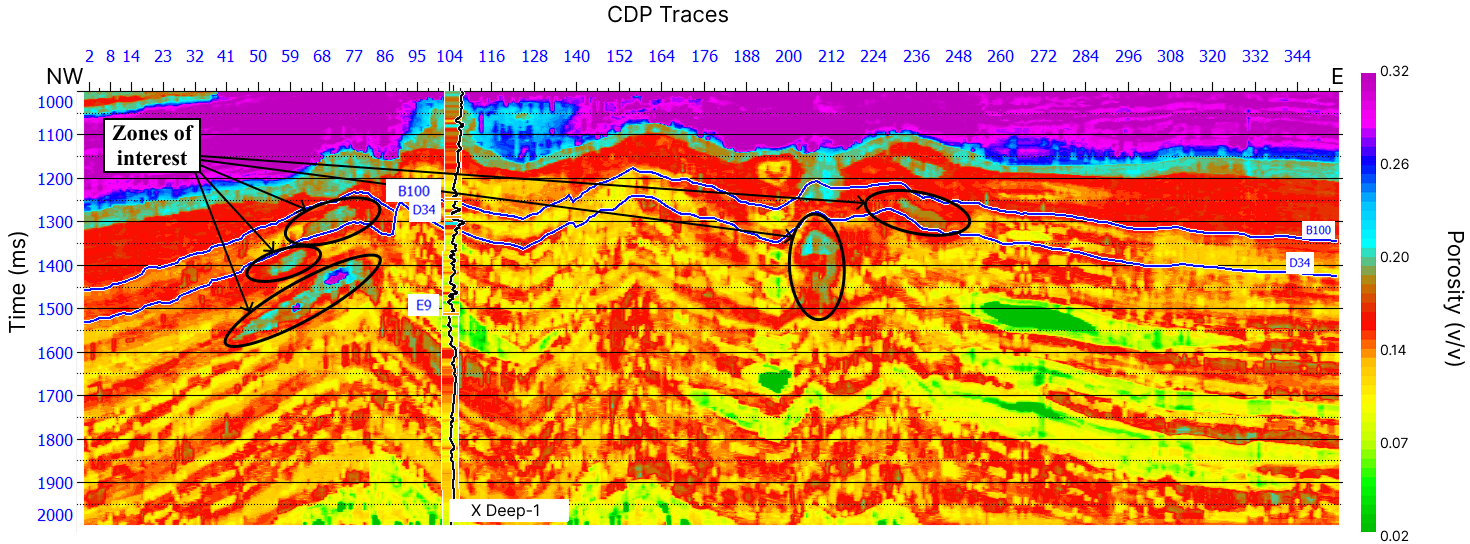
The whole thesis was really about the second half of that sentence. The give or take. So instead of asking the model once, I asked it hundreds of times, each on a slightly reshuffled slice of the data, and watched where the answers landed. Where they agreed, I trusted it. Where they scattered, that scatter was the truth. The rock telling me, honestly, how little I actually knew there. Mean porosity from two to thirty-two percent. And stapled to every value, the size of my own doubt.
It checked out against the impedance, the way geology says it should. Five zones lit up. Two of them sitting right between the horizons where a reservoir would want to be.
Here's the thing, though.
The expensive methods aren't more certain. They just hide the guessing better. Everyone underground is guessing. The only question is whether you're brave enough to publish how much. The honest model isn't the one that sounds sure. It's the one that tells you precisely where it might be wrong, and lets you bet your money accordingly.
That sounds like something I'd put on a poster.
Maybe. But I'd still rather work with someone who says I think it's this, give or take than someone who's never once said give or take and has been wrong the whole time without knowing it.
Three kilometers down, in rock I'll never touch, I don't know the exact answer.
I just finally know the size of what I don't know. That turned out to be the more useful number.
The proper version: repository.its.ac.id/127681